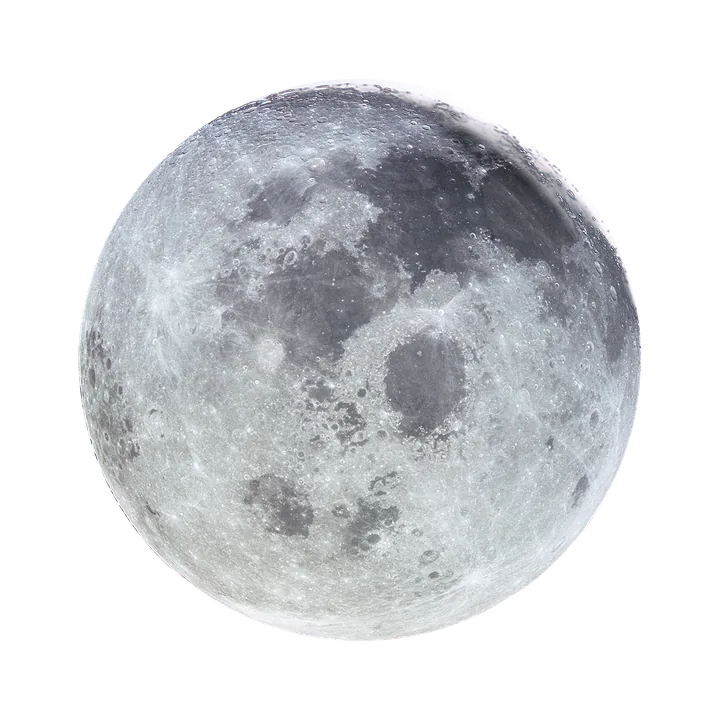
What are the lunar nodes?
The Moon's orbit is tilted about five degrees against the ecliptic, the path the Sun appears to trace across the year. The two points where those two circles intersect are the lunar nodes. They are mathematical points rather than objects, which is why no telescope will ever show you one.
They are also the reason eclipses happen at all. An eclipse needs a New or Full Moon close to a node, which is why eclipses arrive in pairs about a fortnight apart, in seasons roughly every six months, instead of every single month.
What do the North and South Node mean in a chart?
The South Node is read as the familiar: skills, habits and instincts that are already well worn, the things a person falls back on without thinking about them. The North Node is read as the point directly opposite, the less practised direction, the quality a chart keeps nudging its owner toward.
They are always exactly opposite each other, so they are one axis and not two placements. A South Node in Leo means a North Node in Aquarius. The tradition reads the pair as a single question about where effort is worth spending rather than as a judgement on either sign.
How fast do the nodes move?
The nodes drift backwards through the zodiac, taking about 18.6 years to go all the way round and roughly 18 months to cross a single sign. That makes the sign something you share with everyone born around you rather than something personal to you alone.
What makes the axis yours is the houses it falls in, which need a birth time, and the planets it touches. A North Node sitting on somebody's Venus reads very differently from the same North Node sitting in an empty stretch of chart, even though both people share the sign.
Is this the same as karmic astrology?
Some astrologers read the nodes through past lives and treat the South Node as a store of what was carried over. Others read exactly the same axis psychologically, as comfort zone against growth edge, and make no claim about anything before birth.
Natal Junction describes what the nodes are, where they sit and what each tradition reads them as. We do not state what the axis means about a life before this one, because that is a belief rather than something a chart can show.
What is a nodal return?
A nodal return is the moment the moving North Node comes back to the degree it held at your birth, which happens about every 18.6 years. Astrologers mark the ages around 18 or 19, then 37, 56 and 74 as the ordinary rhythm of it.
The half-way points matter to the tradition too, when the nodes sit reversed against their birth positions at roughly 9, 28 and 46. Where the nodes are in the sky now, with dates, sits on our transits pages.
When did the nodes change sign, and where are they in 2027?
The nodes move backwards through the zodiac and change sign every 566 days on average, which is a little over eighteen and a half months. That is slow enough to be worth looking up and fast enough that most people have lived through a dozen shifts. The table below computes every crossing from 2015 to 2035 from the mean node, which is the convention our charts use.
For anyone reading ahead: the North Node entered Aquarius on 19 August 2026 and stays there until 7 March 2028, so it sits in Aquarius for the whole of 2027, with the South Node in Leo opposite it. If you were born with the nodes in those signs, 2027 is a nodal return year for you. The 2027 astrology calendar at /blog/2027-astrology-calendar sets that alongside the year's eclipses, which is the other thing the nodes govern.
| From | North Node in | South Node in |
|---|---|---|
| 10 October 2015 | Virgo | Pisces |
| 28 April 2017 | Leo | Aquarius |
| 16 November 2018 | Cancer | Capricorn |
| 4 June 2020 | Gemini | Sagittarius |
| 23 December 2021 | Taurus | Scorpio |
| 12 July 2023 | Aries | Libra |
| 29 January 2025 | Pisces | Virgo |
| 19 August 2026 | Aquarius | Leo |
| 7 March 2028 | Capricorn | Cancer |
| 25 September 2029 | Sagittarius | Gemini |
| 14 April 2031 | Scorpio | Taurus |
| 1 November 2032 | Libra | Aries |
| 21 May 2034 | Virgo | Pisces |
Computed from the mean node, the convention used throughout our charts, sampled every six hours. Average time in one sign across this window: 566 days. Dates are UTC, so a crossing late in the evening falls on the previous day in the Americas.
Mean node or true node?
There are two defensible answers to where the node is, and most sites quote one without saying which. The true node is the actual intersection of the Moon's orbit with the ecliptic at that instant, and it wobbles, even turning briefly forward before resuming its backward drift. The mean node is that same point with the wobble averaged out, so it moves steadily backwards and never changes direction.
We read the mean node. It keeps ingress dates stable and avoids the awkward case where the true node crosses a sign boundary, slips back over it and crosses again, giving a reader three dates for one event. The two are rarely more than about 1.8 degrees apart, so for a chart reading they almost always give the same sign, and where they differ it is within a day or two of a boundary. If a site gives you a node position a degree or two from ours, this is usually why.
How do you read your own nodal axis?
Read it as one axis, not two placements, and start with the house rather than the sign. The South Node house describes the territory you already know how to operate in, the competence that comes without being asked for. The North Node house, always the opposite one, describes the territory that feels unpractised and is where the tradition says the growth sits. A South Node in the house of home with a North Node in the house of career is a familiar shape: deeply skilled at the private world, learning the public one.
Then add the signs as a description of manner. South Node in Virgo, North Node in Pisces reads as someone fluent in analysis and detail who is learning to tolerate what cannot be solved that way. None of this is a verdict about a past life, and you do not have to accept the reincarnation framing to use the technique. The useful part is the shape it names: the thing you are good at, and the thing you keep circling without entering.
Why do the nodes matter for eclipses?
An eclipse can only happen when a new or full Moon falls close to one of the nodes, because the nodes are exactly where the Moon's path crosses the Sun's. That is why eclipses come in seasons roughly every six months rather than every month, and why they arrive in whichever pair of signs the nodes currently occupy.
It also means the node signs tell you in advance which part of a chart an eclipse season will touch. With the nodes in Aquarius and Leo through 2027, both solar eclipses that year land on that axis: the annular eclipse of 6 February at 17 degrees of Aquarius and the total eclipse of 2 August at 9 degrees of Leo. The lunar eclipses are the looser cases, because a Moon slightly further from the node still clips the faint outer shadow, which is how 2027 also gets penumbral eclipses in Virgo and Capricorn. The eclipse guide at /blog/eclipses-2027 gives every date and where each one is visible.
What does each nodal axis describe?
Because the nodes are always opposite, there are six axes rather than twelve placements, and each pairs two signs that want contradictory things. Aries and Libra sets self against partnership: learning to act alone, or learning to share the decision. Taurus and Scorpio sets what is yours against what is shared, from money to intimacy. Gemini and Sagittarius sets the gathered fact against the larger meaning, which usually reads as learning to stop collecting and commit to a view, or the reverse.
Cancer and Capricorn sets home against public standing, the most quietly demanding of the six for anyone with a family and a career. Leo and Aquarius sets the individual against the group: being willing to be the one who stands out, or being willing to be one of many. Virgo and Pisces sets the solvable against the unsolvable, which is why it so often shows up in people who work in care or in craft. Whichever axis is yours, the tradition reads the North Node end as the unpractised one, and the South Node end as the one you could do in your sleep.