Printable PDF · $5.99 · Five time zone editions
The 2027 Moon Journal
The 2027 Moon Journal ($5.99) is a 35-page printable for anyone who sets intentions at the New Moon and looks back at the full Moon, with a dated page for each of the 13 New Moons of 2027 and the 13 Full Moons that answer them, the last on January 11, 2028, each at the exact time in your own time zone.
Launch price $5.99. The price rises as copies sell, step by step to $7.99.
Last checked 23 October 2026 · How we make it
What's inside the 2027 Moon Journal?
| Part | Pages | Formats |
|---|---|---|
| The journal | 35 | US Letter and A4 |
| Start here guide | 1 | PDF with how the cycle works and how to print |
| README | - | Plain text list of every file |
Every zip holds 3 PDFs. The 35 pages run in this order:
- A cover and a how-to page.
- The year at a glance: all 13 cycles with their dates, signs, full Moon names and eclipses.
- My hopes for 2027.
- 13 New Moon pages and 13 full Moon pages, each with its own question for that cycle.
- Two eclipse season pages with the local times and where each eclipse can be seen.
- A cycle tracker, a year in review and a notes page.
The prompts are questions for reflection only. They describe the sky and ask about your own month.
Sample pages
Real pages from the US Eastern edition, rendered from the delivered PDF. Every other edition has the same pages with its own dates and times.
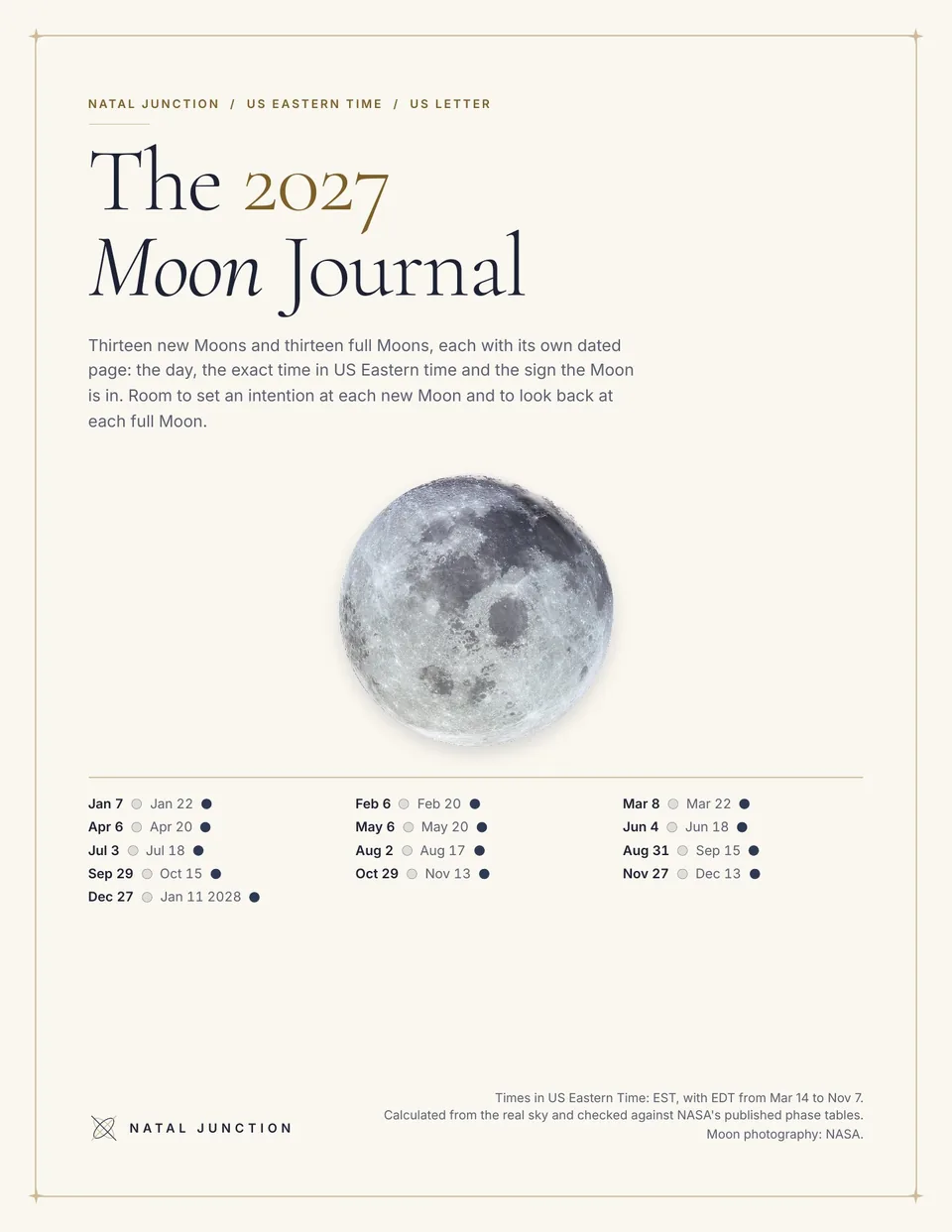
Cover 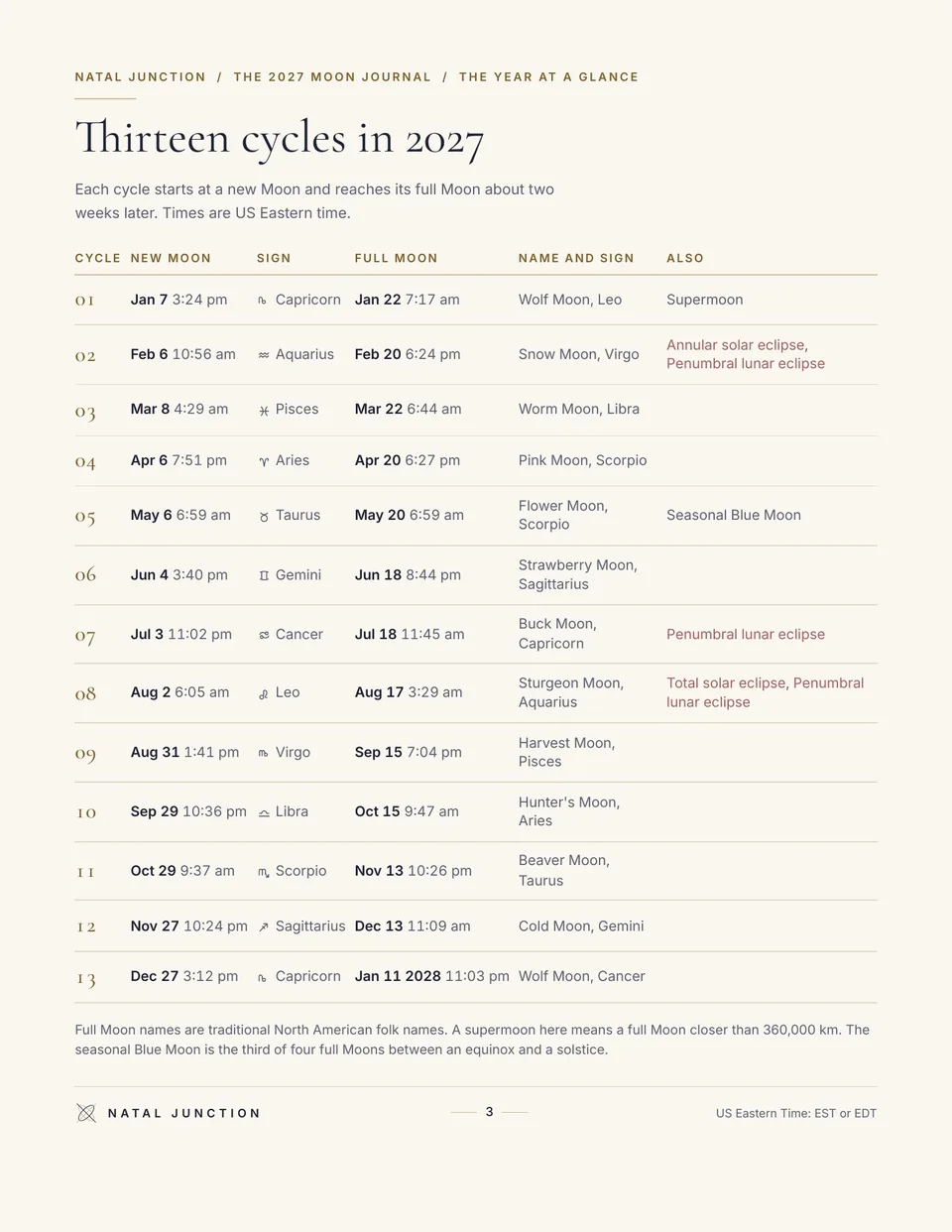
The year at a glance 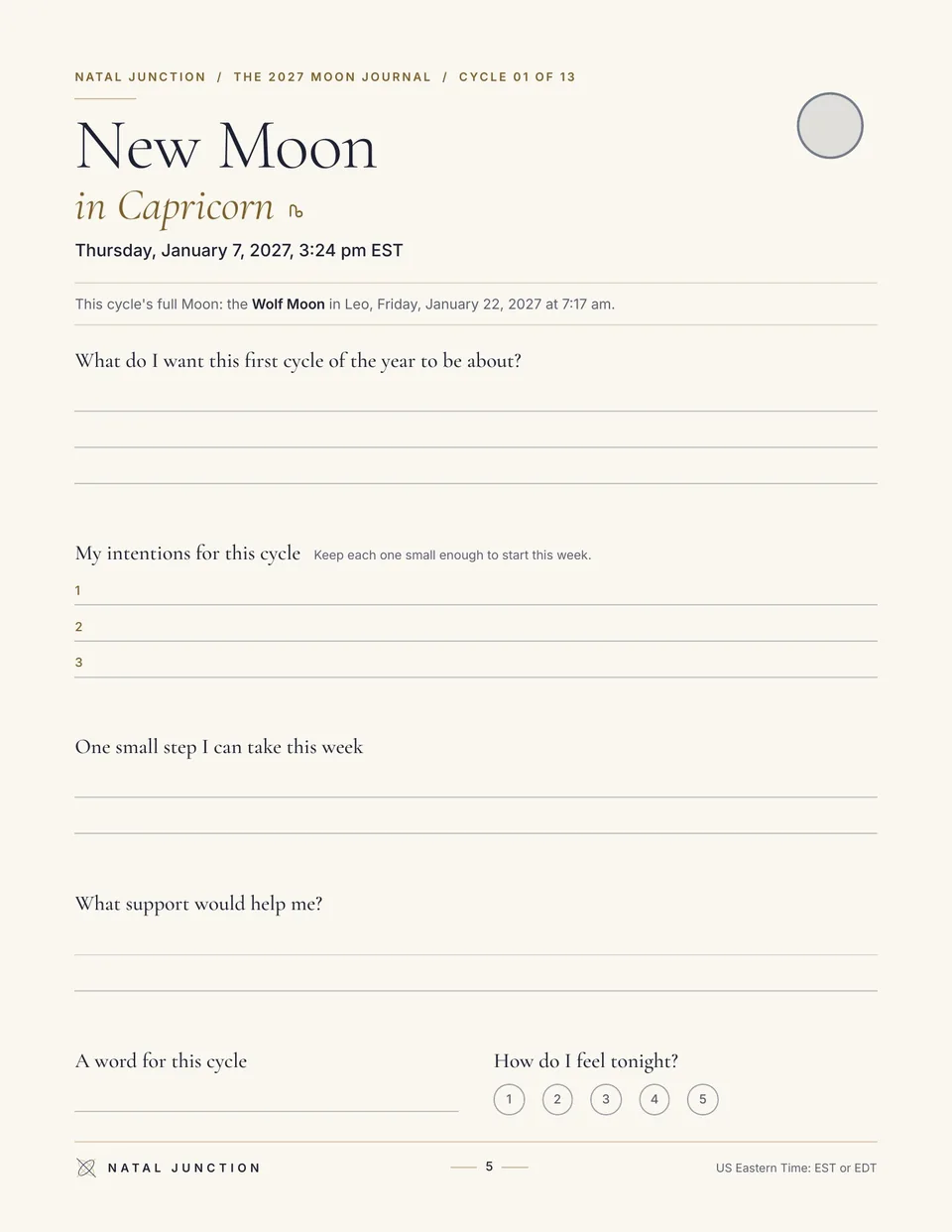
A New Moon page 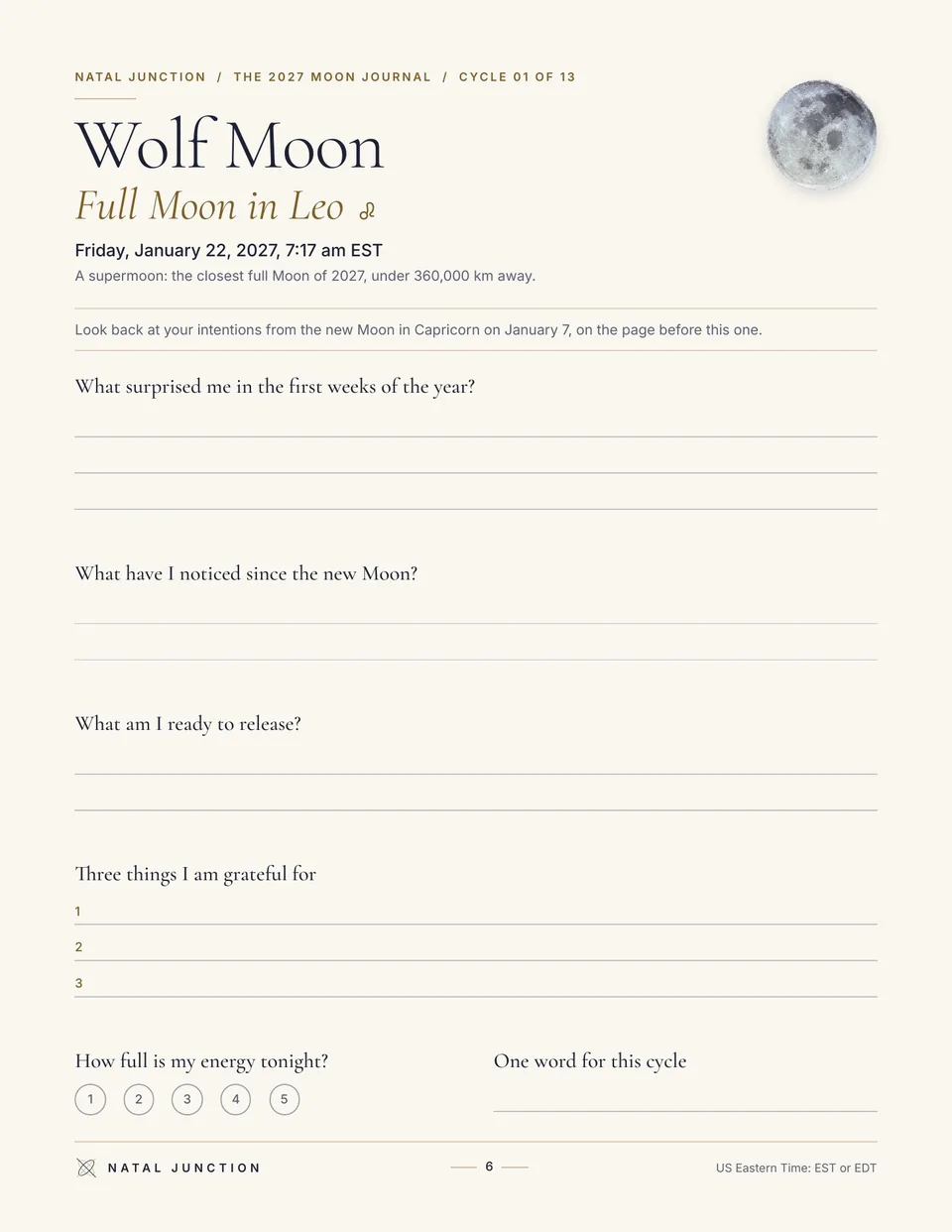
A full Moon page 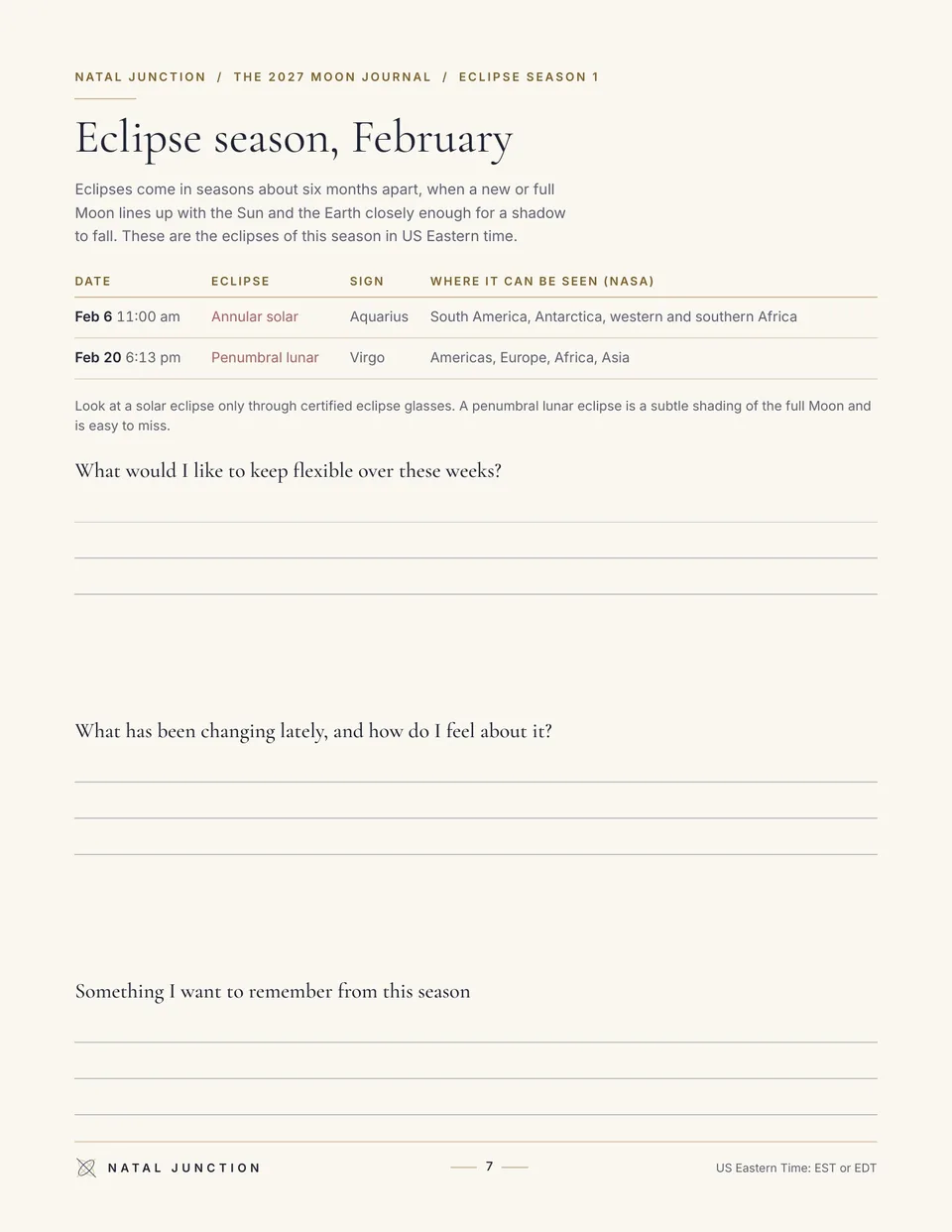
An eclipse season page
Specs
| Spec | Detail |
|---|---|
| Pages | 35, from the first New Moon of 2027 to the full Moon of January 2028 |
| Paper sizes | US Letter and A4 |
| In each zip | The journal in both sizes, a Start here guide and a README |
| Editions | Five time zones: US Eastern, US Pacific, UK, India (IST) and Sydney |
| Files | 3 PDFs per zip; 1.5 MB per zip |
| Format and delivery | Digital download from Gumroad after checkout, one zip per time zone. No physical item is shipped. |
| Data source | Natal Junction's own engine. Every Moon phase and eclipse is checked against NASA Goddard's published tables (Espenak); sign changes and stations are checked against a second, independent calculation. Eclipse visibility from NASA's eclipse tables |
| Price | $5.99 in US dollars. Launch price $5.99. The price rises as copies sell, step by step to $7.99. |
| Refunds | No refunds for a change of mind once a file is downloaded. If you get the wrong time zone edition, or a file will not open or print properly, reply to your receipt and we swap or fix it, with a full refund if we cannot. This does not affect your statutory rights. |
| Last checked | 23 October 2026 |
Which edition do I need?
The one for the clock on your wall. Each edition downloads as its own zip, calculated for its own time zone.
| Edition | Clock in 2027 | Made for | Paper |
|---|---|---|---|
| US Eastern | EST, then EDT from March 14 to November 7 | New York, Atlanta, Miami | US Letter and A4 |
| US Pacific | PST, then PDT from March 14 to November 7 | Los Angeles, Seattle, San Francisco | US Letter and A4 |
| UK | GMT, then BST from March 28 to October 31 | London and the rest of the UK | US Letter and A4 |
| India (IST) | IST all year, no daylight saving | All of India | US Letter and A4 |
| Sydney | AEDT, then AEST from April 4 to October 3 | Sydney, Melbourne, Canberra | US Letter and A4 |
Live in US Central or Mountain time? The Pacific edition carries your date on 48 of the 49 Moon phases of 2027, with clock times one or two hours earlier than yours.
Every page carries its date and time in the edition's own clock, so the same New Moon can sit on a different date in two editions.
Why does the time zone matter?
A Moon phase happens at one instant for the whole Earth, so the clock time and sometimes the date change with where you live. In 2027, 10 of the 13 New Moons fall on a different date in New York than in Sydney. A calendar printed in Universal Time puts 8 of the year's 49 Moon phases on the wrong day for New York and 14 for Los Angeles. That is why every edition is calculated for its own clock, with daylight saving applied on the right day.
| Edition | First New Moon of 2027 | Time |
|---|---|---|
| US Eastern | January 7 | 3:24 pm EST |
| US Pacific | January 7 | 12:24 pm PST |
| UK | January 7 | 20:24 GMT |
| India (IST) | January 8 | 1:54 am IST |
| Sydney | January 8 | 7:24 am AEDT |
The 13 Moon cycles of 2027, US Eastern edition
These are the 26 dated pages as the US Eastern edition prints them. Each New Moon page opens a cycle and the full Moon about two weeks later closes it.
| Cycle | New Moon (US Eastern) | Sign | Full Moon (US Eastern) | Sign |
|---|---|---|---|---|
| 1 | January 7, 3:24 pm EST | 17°18' Capricorn | January 22, 7:17 am EST | 2°14' Leo |
| 2 | February 6, 10:56 am EST (annular eclipse) | 17°38' Aquarius | February 20, 6:24 pm EST | 2°06' Virgo |
| 3 | March 8, 4:29 am EST | 17°35' Pisces | March 22, 6:44 am EDT | 1°35' Libra |
| 4 | April 6, 7:51 pm EDT | 16°57' Aries | April 20, 6:27 pm EDT | 0°37' Scorpio |
| 5 | May 6, 6:59 am EDT | 15°43' Taurus | May 20, 6:59 am EDT | 29°14' Scorpio |
| 6 | June 4, 3:40 pm EDT | 13°58' Gemini | June 18, 8:44 pm EDT | 27°33' Sagittarius |
| 7 | July 3, 11:02 pm EDT | 11°57' Cancer | July 18, 11:45 am EDT | 25°49' Capricorn |
| 8 | August 2, 6:05 am EDT (total eclipse) | 9°55' Leo | August 17, 3:29 am EDT | 24°12' Aquarius |
| 9 | August 31, 1:41 pm EDT (Black Moon) | 8°06' Virgo | September 15, 7:04 pm EDT | 22°53' Pisces |
| 10 | September 29, 10:36 pm EDT | 6°43' Libra | October 15, 9:47 am EDT | 21°59' Aries |
| 11 | October 29, 9:37 am EDT | 5°54' Scorpio | November 13, 10:26 pm EST | 21°31' Taurus |
| 12 | November 27, 10:24 pm EST | 5°39' Sagittarius | December 13, 11:09 am EST | 21°25' Gemini |
| 13 | December 27, 3:12 pm EST | 5°50' Capricorn | January 11, 2028, 11:03 pm EST | 21°28' Cancer |
The thirteenth cycle opens on December 27, 2027 and closes in January 2028, so its full Moon page is dated 2028.
Why are there 13 New Moons in 2027?
A lunar cycle lasts about 29.5 days, so twelve cycles fill only 354 days of the year. The leftover days let a thirteenth New Moon fit inside 2027. August holds two New Moons, on August 2 and August 31, which makes August 31 a Black Moon.
Which 2027 New Moons are eclipses?
Two. The February 6 New Moon in Aquarius is an annular solar eclipse and the August 2 New Moon in Leo is a total solar eclipse. The journal's two eclipse season pages carry the local times and where each one can be seen.
How does printing at home work?
- Print at 100% or "Actual size", never "Fit to page", so the margins and the writing space stay true.
- Print single-sided or double-sided. Every page works on its own.
- Print the whole year at once, or each page as its Moon comes round.
- Any home printer handles US Letter and A4. Matte paper takes pen and pencil best.
How it was made
- Every date and time is computed by Natal Junction's own engine.
- Every Moon phase and eclipse is checked against NASA's published tables; sign changes and stations are checked against a second, independent calculation.
- Each edition is converted to its own clock, with daylight saving on the right day, then rounded to the minute.
- Moon discs show the exact shape only on the four phase days; the days between move in even steps.
- Moon photography: NASA.
Questions people ask
When are the new moons in 2027?
January 7, February 6, March 8, April 6, May 6, June 4, July 4, August 2, August 31, September 30, October 29, November 28 and December 27 (UTC dates). In US Eastern time the July, September and November New Moons fall the evening before: July 3, September 29 and November 27.
Why does the journal have 13 cycles?
2027 has 13 New Moons. The last one, on December 27 (December 28 in India and Sydney), reaches its full Moon on January 11, 2028 in US time, so that page is dated 2028.
Do I need to know astrology to use it?
No. Each page gives the date, the time and the sign. The questions are about your own month, not about the sky.
Which edition do I need?
The one for the clock on your wall. Each of the five editions downloads as its own zip: US Eastern (New York, Atlanta, Miami), US Pacific (Los Angeles, Seattle, San Francisco), UK, India and Sydney (with Melbourne and Canberra). Live in US Central or Mountain time? The Pacific edition carries your date on 48 of the 49 Moon phases of 2027, with clock times one or two hours earlier than yours.
How do I print it, and is it easy to read?
Print at 100% or "Actual size", never "Fit to page", so the margins and the writing space stay true. Print single-sided or double-sided, the whole year at once or each page as its Moon comes round. The questions and dates are set large; the smallest type, 7 pt, is the numbers in the 1 to 5 circles. Every font is embedded and the pages are dark type on a light ground, so ink use stays low.
Does it work in GoodNotes or on a tablet?
Yes, as a regular PDF. Import the US Letter or A4 file into GoodNotes, Notability or any PDF app and write on it with a stylus. It is designed for print, so it has no separate tablet layout or linked tabs. The 2027 Lunar Planner is the product with a hyperlinked tablet edition.
Does it work in the Southern Hemisphere?
The Sydney edition dates every page in Sydney time, AEDT and then AEST from April 4 to October 3, 2027, so the first New Moon of the year is dated January 8 there. Melbourne and Canberra share Sydney's clock. Brisbane, Adelaide, Perth and New Zealand run on other clocks, so a date near midnight can differ from theirs.
Does it predict what 2027 holds for me?
No. It is a dated record of the sky, not a prediction. It prints where the Sun, the Moon and the planets are and when they change, with short notes on what astrologers traditionally associate with each event and questions for your own reflection. Nothing in it says what will happen to you or when to act.
How is it different from a free Moon calendar?
Most free calendars print one clock, often Universal Time or US Eastern time. A calendar printed in Universal Time puts 8 of the 49 Moon phases of 2027 on the wrong day for New York and 14 for Los Angeles. Each edition here is calculated for its own clock with daylight saving on the right day, and every phase is checked against NASA's published table. The journal turns each date into a page of its own, with a question for that cycle and room to write. If you only need the dates, our free full moon calendar 2027 and new moon calendar 2027 list them.
What does it cost, and can I get a refund?
$5.99 in US dollars. Launch price $5.99. The price rises as copies sell, step by step to $7.99. No refunds for a change of mind once a file is downloaded. If you get the wrong time zone edition, or a file will not open or print properly, reply to your receipt and we swap or fix it, with a full refund if we cannot. This does not affect your statutory rights.
Can I give it as a gift?
Yes. Choose the edition for the clock where the person lives, not where you live, then print it at home or at a print shop and give the printed pages. A journal page per Moon makes it a gift that lasts the whole year. The files are licensed for personal use, so please give a printed copy rather than sharing the files.
Full terms: our Refund and Cancellation Policy and Delivery Policy.
The 2027 Moon Journal · $5.99
35 dated pages: a page for each of the 13 New Moons of 2027 and the 13 Full Moons that answer them, in your time zone.
Launch price $5.99. The price rises as copies sell, step by step to $7.99.
Made with: every date and time computed by Natal Junction's own engine. Every Moon phase and eclipse is checked against NASA's published tables (NASA Goddard, Espenak); sign changes and stations are checked against a second, independent calculation. Moon photography: NASA.
Digital download: PDF files in one zip per time zone. No physical item is shipped. For personal use, please do not share or resell the files.
Astrology notes in these files are for reflection and entertainment. They are not predictions or professional advice. For self-reflection and entertainment. Astrological insights drawn from your birth details, not predictions, and not medical, legal, financial or psychological advice. Prices in US dollars.
Last checked 23 October 2026