Eclipse history
The August 2, 2027 Eclipse: Six Minutes of Darkness and How the Ancients Read It
On August 2, 2027 the Moon covers the Sun for up to 6 minutes 23 seconds, the second-longest total eclipse of the 21st century. Babylonian scribes and Ptolemy both had rules for reading a moment like this. Here is the sky and the history.
8 minute readLast checked October 23, 2026
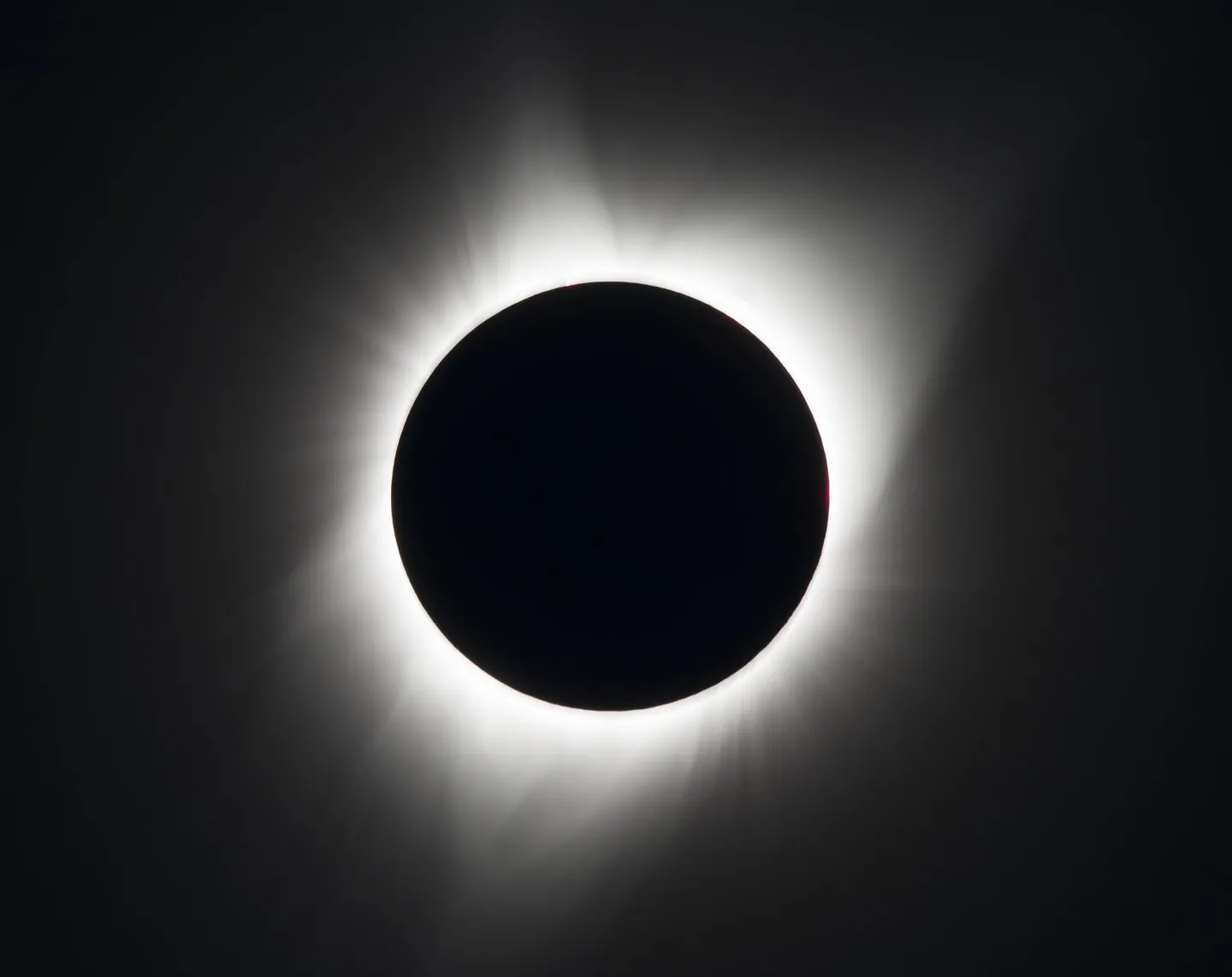
On August 2, 2027 the Moon covers the Sun completely for up to 6 minutes 23 seconds, NASA lists, the second-longest total solar eclipse of the 21st century after July 22, 2009. The shadow crosses southern Spain, Morocco, Algeria, Tunisia, Libya, Egypt, Saudi Arabia and Yemen, and the longest darkness falls near Luxor in Egypt. It is long because the Moon is close to Earth, Earth is near its farthest from the Sun and the shadow passes almost under the Sun. The eclipse falls at 9 degrees 55 minutes of Leo. Babylonian scribes and Ptolemy both wrote rules for reading eclipses like this one, and both are below, attributed.
The facts
| Fact | Value | Source |
|---|---|---|
| Greatest eclipse | August 2, 2027, 10:06:34 UT (6:06 am ET)NASA Goddard eclipse catalogue (2026 check) | NASA Goddard eclipse catalogue (2026 check) |
| Longest totality | 6 min 23 sNASA Goddard eclipse catalogue | NASA Goddard eclipse catalogue |
| Eclipse magnitude | 1.079NASA Goddard eclipse catalogue | NASA Goddard eclipse catalogue |
| Width of the path | 257.7 kmNASA Goddard eclipse catalogue | NASA Goddard eclipse catalogue |
| Saros series | 136, which also gave the 6 min 39 s eclipse of July 22, 2009NASA Goddard eclipse catalogue | NASA Goddard eclipse catalogue |
| Countries in the path | Southern Spain, Morocco, Algeria, Tunisia, Libya, Egypt, Saudi Arabia, YemenNASA Science, Future Eclipses (2026 check) | NASA Science, Future Eclipses (2026 check) |
| Totality at Luxor, Egypt | 6 min 21 s, Sun 82° highComputed with NASA's lunar radius, Natal Junction ephemeris (2026) | Computed with NASA's lunar radius, Natal Junction ephemeris (2026) |
| Moon's distance | 357,375 km, near its closest of the yearComputed (2026) | Computed (2026) |
| Zodiac position | 9°55′ LeoComputed, tropical (2026) | Computed, tropical (2026) |
August 2, 2027 total solar eclipse facts. NASA values are quoted from NASA's eclipse catalogue.
Six minutes and twenty-three seconds
Most total eclipses are short. The Moon is only just big enough in our sky to hide the Sun, so totality usually lasts two or three minutes. On August 2, 2027 NASA gives the longest totality as 6 minutes 23 seconds. Only one total eclipse this century runs longer: July 22, 2009, at 6 minutes 39 seconds, over Asia and the Pacific.
Three things line up to stretch it.
The Moon is close. At the moment of new moon it is 357,375 km from Earth, only hours after its closest point of the month and near its closest of the year. A closer Moon looks bigger and casts a wider shadow.
The Sun is far. Earth reaches its farthest point from the Sun, called aphelion, every July. On August 2 we are still near it, so the Sun looks slightly smaller than average and is easier to cover. NASA's eclipse magnitude of 1.079 means the Moon's disc is almost 8% wider than the Sun's, seen from the ground under the shadow.
The shadow passes nearly under the Sun. At greatest eclipse, near Luxor, the Sun stands 82 degrees up, almost overhead. That puts the ground as close to the Moon as it can be, and the turning Earth carries observers along in the same direction the shadow moves, so the shadow takes longer to pass.
Two eclipses, one year
The Moon is just big enough on August 2, and just too small on February 6
- Km to the Moon, Aug 2
- 357,375
- Km to the Moon, Aug 2
- Moon's width, Aug 2
- 33.4′
- Moon's width, Aug 2
- Sun's width, Aug 2
- 31.5′
- Sun's width, Aug 2
The Sun and Moon drawn at their true apparent sizes at each 2027 solar eclipse. On February 6 the Moon is 402,696 km away and looks 29.7 arcminutes wide against a Sun of 32.4, so a ring of Sun stays visible: an annular eclipse. On August 2 the Moon is 357,375 km away, near its closest, and looks 33.4 arcminutes wide against a Sun of 31.5, so it covers the Sun completely for minutes.
The Moon is just big enough on August 2, and just too small on February 6Computed from the real sky with the Natal Junction ephemeris (astronomy-engine, geocentric). Times shown are as labelled. Apparent widths from the Moon's radius of 1,737.4 km and the Sun's of 696,000 km at the computed geocentric distances; both discs are outlines, not pictures.
Where the shadow falls
The Moon's dark shadow touches down in the Atlantic, comes ashore at the Strait of Gibraltar in the morning, runs along the North African coast, crosses Egypt around midday and reaches Arabia in the early afternoon before leaving land over the Indian Ocean. NASA lists the countries in the path as southern Spain, Morocco, Algeria, Tunisia, Libya, Egypt, Saudi Arabia and Yemen, and gives the path a width of about 258 km.
We computed the local circumstances for eight places inside it. Cadiz, on the edge of the path, gets under three minutes. Tangier, closer to the centre line, gets almost five. Benghazi gets just over six, and Luxor 6 minutes 21 seconds with the Sun nearly straight up, two seconds short of the maximum NASA gives for a spot a little further along the path. Outside the path the eclipse is partial: London sees about 42% of the Sun's disc covered, Cairo about 95%.
NASA's safety rule is simple. It is safe to look at the Sun without protection only when the Moon completely blocks its bright face. Before and after totality, and anywhere outside the path, use solar viewers that meet the ISO 12312-2 standard; ordinary sunglasses are not enough.
August 2, 2027 · computed
How long the Sun disappears, from Spain to Yemen
- NASA's longest, min:s
- 6:23
- NASA's longest, min:s
- Luxor, longest of these
- 6:21
- Luxor, longest of these
- Width of the path (NASA)
- 258 km
- Width of the path (NASA)
Minutes of totality · gridlines every minute
Totality on August 2, 2027 at eight places inside the path, west to east. Cadiz: 2 min 48 s starting 10:45 am local time; Gibraltar: 4 min 25 s starting 10:45 am local time; Tangier: 4 min 50 s starting 9:44 am local time; Benghazi: 6 min 09 s starting 11:27 am local time; Luxor: 6 min 21 s starting 1:01 pm local time; Jeddah: 5 min 58 s starting 1:22 pm local time; Mecca: 5 min 06 s starting 1:24 pm local time; Sanaa: 2 min 24 s starting 1:44 pm local time. The longest of these is Luxor at 6 min 21 s, close to NASA's maximum of 6 minutes 23 seconds.
How long the Sun disappears, from Spain to YemenTotality by city, computed
| City | Totality begins (local) | Duration | Sun altitude |
|---|---|---|---|
| Cadiz, Spain | 10:45 am (08:45 UTC) | 2 min 48 s | 37° |
| Gibraltar, Gibraltar | 10:45 am (08:45 UTC) | 4 min 25 s | 38° |
| Tangier, Morocco | 9:44 am (08:44 UTC) | 4 min 50 s | 38° |
| Benghazi, Libya | 11:27 am (09:27 UTC) | 6 min 09 s | 68° |
| Luxor, Egypt | 1:01 pm (10:01 UTC) | 6 min 21 s | 82° |
| Jeddah, Saudi Arabia | 1:22 pm (10:22 UTC) | 5 min 58 s | 76° |
| Mecca, Saudi Arabia | 1:24 pm (10:24 UTC) | 5 min 06 s | 75° |
| Sanaa, Yemen | 1:44 pm (10:44 UTC) | 2 min 24 s | 67° |
Computed from the real sky with the Natal Junction ephemeris (astronomy-engine, geocentric). Times shown are as labelled. Contacts for an observer at sea level, using NASA's lunar radius for totality (k = 0.272281); on the same model the longest totality anywhere on the path comes out at NASA's 6 min 23 s.
How Babylonian scribes read an eclipse
For the scholars of ancient Mesopotamia an eclipse was a message, and they kept a reference book for reading it. The omen series known by its first words, Enūma Anu Enlil, ran to 68 or 70 clay tablets and an estimated 6,500 to 7,000 omens. It was probably put into its standard form in the Kassite period, between about 1595 and 1157 BCE. Tablets 15 to 22 deal with eclipses of the Moon and tablets 30 to 39 with eclipses of the Sun.
The omens were read for the king and the state, not for private people. For a lunar eclipse the scribes looked at the date, the watch of the night and which quarter of the Moon's face darkened first, and used them to work out which lands and cities the eclipse concerned.
The most dramatic response comes from the Assyrian court of the 600s BCE. When an eclipse was read as a threat to the king, a substitute king could be put on the throne to take the danger on himself while the real king stepped aside. Every recorded performance of this ritual can be traced to an eclipse, and King Esarhaddon had it done seven times. The danger was believed to fall within 100 days of the eclipse; records mention substitute reigns of 47, 20, 7 and even 3 days.
The first and most potent cause of such events lies in the conjunctions of the sun and moon at eclipse.
Ptolemy's rules for eclipses
In the second century the astronomer Claudius Ptolemy, working in Roman Alexandria, wrote the Tetrabiblos, a four-book survey of astrology. Its second book is about the astrology of whole peoples and places, and eclipses sit at its centre. To Ptolemy an eclipse was the single strongest signal in the sky for events on that scale.
He read an eclipse by where it fell, when it fell and how long it lasted. For the place he looked at where on Earth the eclipse could be seen and which zodiac sign it fell in. For the duration he gave a rule of thumb: the significance of a solar eclipse ran for as many years as the eclipse lasted in hours, and that of a lunar eclipse for as many months.
Ptolemy was also part of a long tradition of telling eclipse stories. Six centuries before him, Herodotus wrote that a battle between the Lydians and the Medes stopped when "day was on a sudden changed into night", that both sides moved to make peace and that Thales of Miletus had foretold it. The eclipse that fits is May 28, 585 BCE. Modern historians doubt that Thales could have known it was coming, since the Moon's role in eclipses was understood only later.
How astrologers read it today
Western astrologers today read an eclipse personally as well as collectively. The key is its degree: 9 degrees 55 minutes of Leo. Astrologers look for that degree in a birth chart, note the house it falls in and look for planets within a few degrees of it. They read the eclipse as a sharpened new moon for that part of the chart. This one falls about a degree and a half from the Moon's South Node, which astrologers associate with release and letting go.
It is the second and last solar eclipse in Leo of this pass of the nodes, after the solar eclipse of August 2026. The whole year's set, with the annular eclipse of February 6 and the lunar eclipses, is in Eclipses 2027, and the day itself, with local times by zone, is in our August 2, 2027 eclipse guide.
Saros 136 · computed
Eclipses come in families, 18 years and 11 days apart
- Days in one saros
- 6,585.3
- Days in one saros
- Between family members
- 18 y 11 d
- Between family members
Four total solar eclipses one saros apart: Jul 11, 1991 with the Sun at 18°59′ Cancer; Jul 22, 2009 with the Sun at 29°27′ Cancer; Aug 2, 2027 with the Sun at 9°55′ Leo; Aug 12, 2045 with the Sun at 20°25′ Leo. Each repeats the last with the Sun about 10.5 degrees further along the zodiac and the shadow about a third of the way further around the Earth, because a saros is 6,585.3 days, not a whole number.
Eclipses come in families, 18 years and 11 days apartThe four eclipses
| Date (UTC) | Type | Sun's position | Greatest eclipse near |
|---|---|---|---|
| Jul 11, 1991 | total | 18°59′ Cancer | 22°N 105°W |
| Jul 22, 2009 | total | 29°27′ Cancer | 24°N 144°E |
| Aug 2, 2027 | total | 9°55′ Leo | 25°N 33°E |
| Aug 12, 2045 | total | 20°25′ Leo | 26°N 79°W |
Computed from the real sky with the Natal Junction ephemeris (astronomy-engine, geocentric). Times shown are as labelled. Saros series number from NASA's eclipse catalogue.
Eclipse seasons · 2027
Why 2027's eclipses come in two seasons
- eclipses
- 5
- eclipses
- solar
- 2
- solar
- lunar
- 3
- lunar
A zodiac wheel of the 2027 eclipses, computed from the ephemeris. The lunar nodes are the two points where the Moon's tilted orbit crosses the Sun's path. An eclipse can only happen while the Sun is within about 18.5 degrees of a node, so 2027 has 2 eclipse seasons: Jan 23, 2027 to Feb 26, 2027, around the North Node in Aquarius and Jul 16, 2027 to Aug 22, 2027, around the South Node in Leo. The 5 eclipses are: a annular solar eclipse on February 6, 2027 at 17 degrees 38 minutes Aquarius, a penumbral lunar eclipse on February 20, 2027 at 1 degrees 59 minutes Virgo, a penumbral lunar eclipse on July 18, 2027 at 25 degrees 58 minutes Capricorn, a total solar eclipse on August 2, 2027 at 9 degrees 55 minutes Leo and a penumbral lunar eclipse on August 17, 2027 at 24 degrees 4 minutes Aquarius.
Why 2027's eclipses come in two seasonsThe outer track is the Sun's path through the year; the inner track is where the full Moon stands, opposite the Sun. The dashed lines are the lunar nodes. While the Sun is within 18.5° of one, a new moon can eclipse the Sun and a full moon at the other node can be eclipsed.
- Annular solar eclipse · Feb 6, 2027Sun at 17°38′ Aquarius, North Node season
- Penumbral lunar eclipse · Feb 20, 2027Moon at 1°59′ Virgo, North Node season
- Penumbral lunar eclipse · Jul 18, 2027Moon at 25°58′ Capricorn, South Node season
- Total solar eclipse · Aug 2, 2027Sun at 9°55′ Leo, South Node season
- Penumbral lunar eclipse · Aug 17, 2027Moon at 24°04′ Aquarius, South Node season
Every eclipse of 2027, with times
| Date | Eclipse | Time | Position | Near |
|---|---|---|---|---|
| Feb 6, 2027 | Annular solar eclipse | 10:59 am ET (15:59 UTC) | Sun at 17°38′ Aquarius | North Node, 3.3° from the Sun |
| Feb 20, 2027 | Penumbral lunar eclipse | 6:12 pm ET (23:12 UTC) | Moon at 1°59′ Virgo | North Node, 11.9° from the Sun |
| Jul 18, 2027 | Penumbral lunar eclipse | 12:02 pm ET (16:02 UTC) | Moon at 25°58′ Capricorn | South Node, 16.5° from the Sun |
| Aug 2, 2027 | Total solar eclipse | 6:06 am ET (10:06 UTC) | Sun at 9°55′ Leo | South Node, 1.6° from the Sun |
| Aug 17, 2027 | Penumbral lunar eclipse | 3:13 am ET (07:13 UTC) | Moon at 24°04′ Aquarius | South Node, 13.4° from the Sun |
The eclipse seasons
| Season | Sun within 18.5° of the node | Node position |
|---|---|---|
| North Node season | Jan 23, 2027 to Feb 26, 2027 | 20°44′ Aquarius |
| South Node season | Jul 16, 2027 to Aug 22, 2027 | 11°27′ Leo |
Computed from the real sky with the Natal Junction ephemeris (tropical zodiac, geocentric). Dates in US Eastern time.
To find where 9°55′ Leo sits in your own chart, cast your free birth chart. The new moon that makes this eclipse is one of the thirteen in Why 2027 Has 13 New Moons.
Questions to sit with
- The scribes of Babylon read an eclipse for a whole kingdom. If you read one for your own year, which part of life would you look at?
- What would you want to be doing during six minutes of daytime darkness, and who would you want beside you?
- Is there something in your life that started around the Leo eclipse of August 2026 and feels like it is still unfolding?
Sources and method
- NASA Goddard Space Flight Center, Total Solar Eclipse of 2027 August 02 (eclipse catalogue entry). Greatest eclipse time, 6 min 23 s, magnitude 1.0790, path width 257.7 km, saros 136
- NASA Goddard Space Flight Center, Total Solar Eclipse of 2009 July 22 (eclipse catalogue entry). Central duration 6 min 39 s, saros 136
- NASA Science, Future Eclipses. Countries inside the path of totality
- NASA Science, Eclipse safety. Safe viewing only during totality; ISO 12312-2 viewers otherwise
- Wikipedia, Enūma Anu Enlil. Tablet count, omen count, dating and the eclipse tablets
- Wikipedia, Substitute king ritual. Eclipse triggers, Esarhaddon, the 100-day window (after Parpola, Letters from Assyrian Scholars, 1983)
- Ptolemy, Tetrabiblos, Book II, trans. F. E. Robbins, Loeb Classical Library (1940), via LacusCurtius. Chapters 4 to 6 on eclipses and their duration
- Wikipedia, Eclipse of Thales. Herodotus, Histories 1.74, and the modern doubts
- Astronomy Engine by Don Cross (open source). Local circumstances, distances and saros neighbours; totality uses NASA's lunar radius k = 0.272281
Sky positions, lunations, eclipse circumstances and rise times are computed with the open-source astronomy-engine ephemeris that powers our free birth chart (tropical zodiac, geocentric), and checked against NASA's published tables where NASA publishes one. Every computed number comes from one reproducible script, rerun on the "last checked" date at the top of this page. Planet photography: NASA. This story describes the sky and how astrologers have read it; it is for reflection and entertainment, not a prediction.