The Jupiter Mahadasha: 16 Years, Measured
Sixteen years under the great benefic. Not among the longest periods in the cycle, and yet more people reach it than reach any of the other eight.
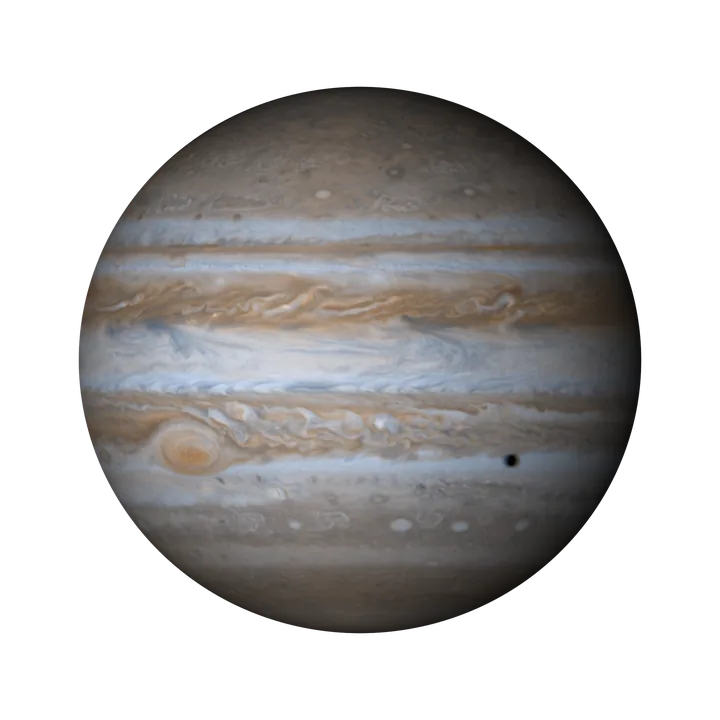
The Jupiter mahadasha runs 16 years, which makes it only the fifth longest of the nine. And yet more people live through a Jupiter period than through any other in the system. 85.62% reach it, a higher share than Venus, Saturn or Rahu, each of which is longer.
Sixteen years out of a hundred and twenty
The Vimshottari cycle hands a notional 120 years to the nine lords in a fixed order, Ketu, Venus, Sun, Moon, Mars, Rahu, Jupiter, Saturn then Mercury. Jupiter sits seventh and takes 16 years.
Jupiter owns three nakshatras: Punarvasu, Vishakha and Purva Bhadrapada. A Moon in any of them at birth opens the sequence with Jupiter.
The most widely reached period in the system
| Measure | Jupiter |
|---|---|
| Length of the mahadasha | 16 years |
| Share of the full 120 year cycle | 13.33% |
| Born into it | 11.11% |
| Share of the years in an 80 year life | 14.87% |
| Runs it at some point before 80 | 85.62% |
| Never runs it before 80 | 14.38% |
| Mean age it begins, where it begins at all | 34.5 |
Source: Natal Junction, exact integration over 1,800,000 birth cases, 20 November 2026.
Put the nine miss rates in order and Jupiter comes out lowest. Only 14.38% of lives never reach a Jupiter mahadasha, against 14.62% for Rahu, 17.46% for Saturn, 28.57% for Venus and 32.72% for the Sun.
Venus is four years longer than Jupiter and is missed twice as often. That comparison, more than any single figure, is the argument these nine pages are built around: the length of a period tells you how long it lasts, not how likely you are to see it.
What actually determines it
Whether a period reaches a life depends on how much of the cycle lies between the birth point and it, and on how many births land in that reachable stretch.
Jupiter sits seventh, which means six lords run ahead of it: Ketu, Venus, the Sun, the Moon, Mars and Rahu. Four of those six are the short periods, Ketu at 7, the Sun at 6, the Moon at 10 and Mars at 7, and short periods collect births densely, because every lord takes one ninth of all births regardless of how many years it has to spread them over.
So a large share of all births land in a stretch of the cycle with a clear run to Jupiter inside a normal lifetime. Jupiter also benefits from sitting after Rahu rather than before it: the 18 years of Rahu are in front of the births behind it, not between them and Jupiter.
Jupiter's share of an 80 year life, 14.87%, likewise exceeds its 13.33% share of a full cycle, for the same reason.
The sixteen years from the inside
Each mahadasha divides into nine antardashas, in the fixed order, each proportional to its own lord's length.
| Sub-period | Years | Roughly |
|---|---|---|
| Ketu | 0.93 | 11 months |
| Venus | 2.67 | 2 years 8 months |
| Sun | 0.80 | 10 months |
| Moon | 1.33 | 1 years 4 months |
| Mars | 0.93 | 11 months |
| Rahu | 2.40 | 2 years 5 months |
| Jupiter | 2.13 | 2 years 2 months |
| Saturn | 2.53 | 2 years 6 months |
| Mercury | 2.27 | 2 years 3 months |
Jupiter's own sub-period, which opens the run, lasts two years and two months. The Venus sub-period is the longest here at two years eight months and the Sun's the shortest at about ten months. Four of the nine run past two years, so as with the other long periods the pratyantardasha does a good deal of the work in practice.
What the tradition reads into it
Guru is the great benefic of Jyotish, read as wisdom, teaching, law, philosophy, children, wealth and expansion. The name means teacher. It is the counsellor in the planetary cabinet, and classical material treats a well placed Jupiter as the single most protective feature a chart can have.
Jupiter's aspect carries particular weight. Every graha is read as looking at the seventh house from itself, but Jupiter additionally looks at the fifth and the ninth, and those extra sights are read as protective wherever they land. This is why Jupiter aspecting Mars appears among the accepted exceptions that cancel Manglik dosha, a rule set out with its measured frequency on the doshas page.
There is a caution the tradition is clear about and popular summaries tend to drop. Jupiter expands whatever it touches, which is not uniformly welcome, and Jupiter in a difficult house or in Capricorn, where it is debilitated, is not read as a quiet sixteen years of good news. The classical position is that a benefic badly placed is still badly placed.
The three doorways in
Jupiter opens from 20 degrees of the air signs, and all three of its nakshatras cross into water. Punarvasu runs from Gemini into Cancer, Vishakha from Libra into Scorpio and Purva Bhadrapada from Aquarius into Pisces.
The pattern holds for every lord. Three nakshatras spaced nine apart is exactly 120 degrees, which is the distance between signs of one element, so a lord's doorways always share a starting element. Jupiter's start on air and finish on water.
| Nakshatra | Sidereal span | Deity | Symbol |
|---|---|---|---|
| Punarvasu | 20°00' Gemini to 3°20' Cancer | Aditi | Quiver of arrows |
| Vishakha | 20°00' Libra to 3°20' Scorpio | Indra-Agni | Triumphal archway |
| Purva Bhadrapada | 20°00' Aquarius to 3°20' Pisces | Aja Ekapada | Front of a funeral cot |
Punarvasu is the gentlest of the three, with Aditi, the mother of the gods, as its deity and a quiver of arrows as its symbol. Its name means return, or light restored. Vishakha belongs jointly to Indra and Agni, which is unusual, and takes a triumphal archway. Purva Bhadrapada takes Aja Ekapada, the one footed goat, and the front legs of a funeral cot, and it is the sombre end of a set that popular writing treats as uniformly benign. Jupiter's three doorways are not interchangeable, and a practitioner reads which one opened before saying anything about the sixteen years.
Where the Moon stood inside its nakshatra decides how much of the period remained at birth:
| Quarter of the nakshatra | Share of the period left | Years left to run |
|---|---|---|
| Pada 1 | 75% to 100% | 12 years to 16 years |
| Pada 2 | 50% to 75% | 8 years to 12 years |
| Pada 3 | 25% to 50% | 4 years to 8 years |
| Pada 4 | 0% to 25% | 0 months to 4 years |
6.25% of people born under Jupiter have under a year of it left, a sixteenth, which is among the smallest shares in the system.
Put that with the headline figure and Jupiter's case is complete. It is the period most lives reach at 85.62%, it is rarely cut to a fragment when it opens a life, and it takes a larger slice of eighty years than it does of the notional hundred and twenty. On reach, on share and on balance at birth, Jupiter is the period a person is most likely to genuinely receive. Not the longest, and not the one most written about.
What it needs in order to be computed
The Moon's nakshatra and the fraction of it already travelled, so a birth time.
On a 16 year period a few minutes of uncertainty will not remove the period from the timeline, but it moves every boundary inside it, and the sub-period is what a practitioner reads. A sequence printed to the day from a time recorded as "morning" is offering precision it does not have.
The free Kundali computes the whole sequence and names the period running today, and says what it assumed when the time is missing. The dasha overview covers how the 120 years are divided.
What this page does not do
It does not say what sixteen years of Jupiter brings. It sets out how the period is reached, what the tradition holds and what the arithmetic measures.
The figure worth keeping is 85.62%. Of the nine periods in the system, the one most people actually live through is not the longest, and it is not the one most often written about. It is Jupiter.
Frequently asked questions
How long is a Jupiter mahadasha?
Sixteen years, the fifth longest of the nine Vimshottari periods. Venus runs twenty, Saturn nineteen, Rahu eighteen and Mercury seventeen. Jupiter's sixteen years are 13.33% of the full 120 year cycle and 14.87% of the years in an 80 year life.
Which mahadasha do most people actually live through?
Jupiter. We measured 85.62% of lives reaching a Jupiter mahadasha before the age of 80, the highest of the nine, just ahead of Rahu at 85.38%. Venus is four years longer and is missed more than twice as often, at 28.57%, because the length of a period decides how long it lasts rather than how likely you are to reach it.
Which nakshatras begin life in a Jupiter mahadasha?
Punarvasu, Vishakha and Purva Bhadrapada. A Moon in any of those three at birth opens the dasha sequence with Jupiter, with some part of the sixteen years already elapsed depending on how far the Moon had travelled into the nakshatra.
Is a Jupiter mahadasha always a good period?
That is not a question this site answers, but the classical position is worth stating: a benefic badly placed is still badly placed. Jupiter is read as expanding whatever it touches, which is not uniformly welcome, and Jupiter debilitated in Capricorn or sitting in a difficult house is not treated as sixteen quiet years. The placement is read before anything is said about the period.
Why does Jupiter's aspect matter so much?
Every graha is read as looking at the seventh house from itself. Jupiter additionally looks at the fifth and the ninth, and those extra sights are read as protective wherever they fall. It is why Jupiter aspecting Mars sits among the accepted exceptions that cancel Manglik dosha, a rule we have measured and published with its frequency.
Is Purva Bhadrapada a difficult nakshatra?
It is the sombre one of Jupiter's three. Its deity is Aja Ekapada, the one footed goat, and its symbol is the front legs of a funeral cot, which is not what a reader of popular Jupiter material would anticipate. Classical texts do not treat Jupiter's three doorways as interchangeable, and a practitioner looks at which of Punarvasu, Vishakha or Purva Bhadrapada opened the sequence before saying anything about the sixteen years.
How much of a Jupiter mahadasha is left if I was born in the last pada?
Between nothing and four years. Each nakshatra divides into four padas of 3 degrees 20 minutes, and the fourth pada covers the final quarter of the arc, so at most a quarter of the sixteen years remains. Only 6.25% of people born under Jupiter have under a single year left, because one year is a sixteenth of sixteen.
How often does a Jupiter antardasha come round?
Once inside every mahadasha, so nine times across a full cycle. Their lengths vary with the governing lord, from about ten months inside a Sun mahadasha to two years eight months inside a Venus one. Added together across the whole 120 years they come to exactly sixteen years, the same as the Jupiter mahadasha itself, and that identity holds for all nine lords.
Which mahadasha comes after Jupiter?
Saturn, for nineteen years. Jupiter sits between Rahu and Saturn in the fixed order, and those three together run 53 consecutive years, the longest unbroken stretch anywhere in the cycle. Jupiter and Saturn alone come to 35 years back to back, second only to Saturn followed by Mercury at 36. A chart that opens its Rahu mahadasha in early adulthood can therefore spend almost the whole of the rest of a normal life inside just three lords.
Your Birth Chart Report
Your own chart, computed and read
A personal report reads your Western chart in full. The free Kundali on this site computes your sidereal chart, your nakshatra and the dasha period running today.
For self-reflection and entertainment. Astrological insights drawn from your birth details, not predictions, and not medical, legal, financial or psychological advice.