The Rahu Mahadasha: 18 Years, Measured
Eighteen years under the north node, a point with no body. Not the longest period in the cycle, and yet it takes the largest share of an actual life.
The Rahu mahadasha runs 18 years. It is only the third longest of the nine, behind Venus at 20 and Saturn at 19, and yet it takes a larger share of a real human life than either of them. That is the measured result and it is not an error.
A period belonging to nothing
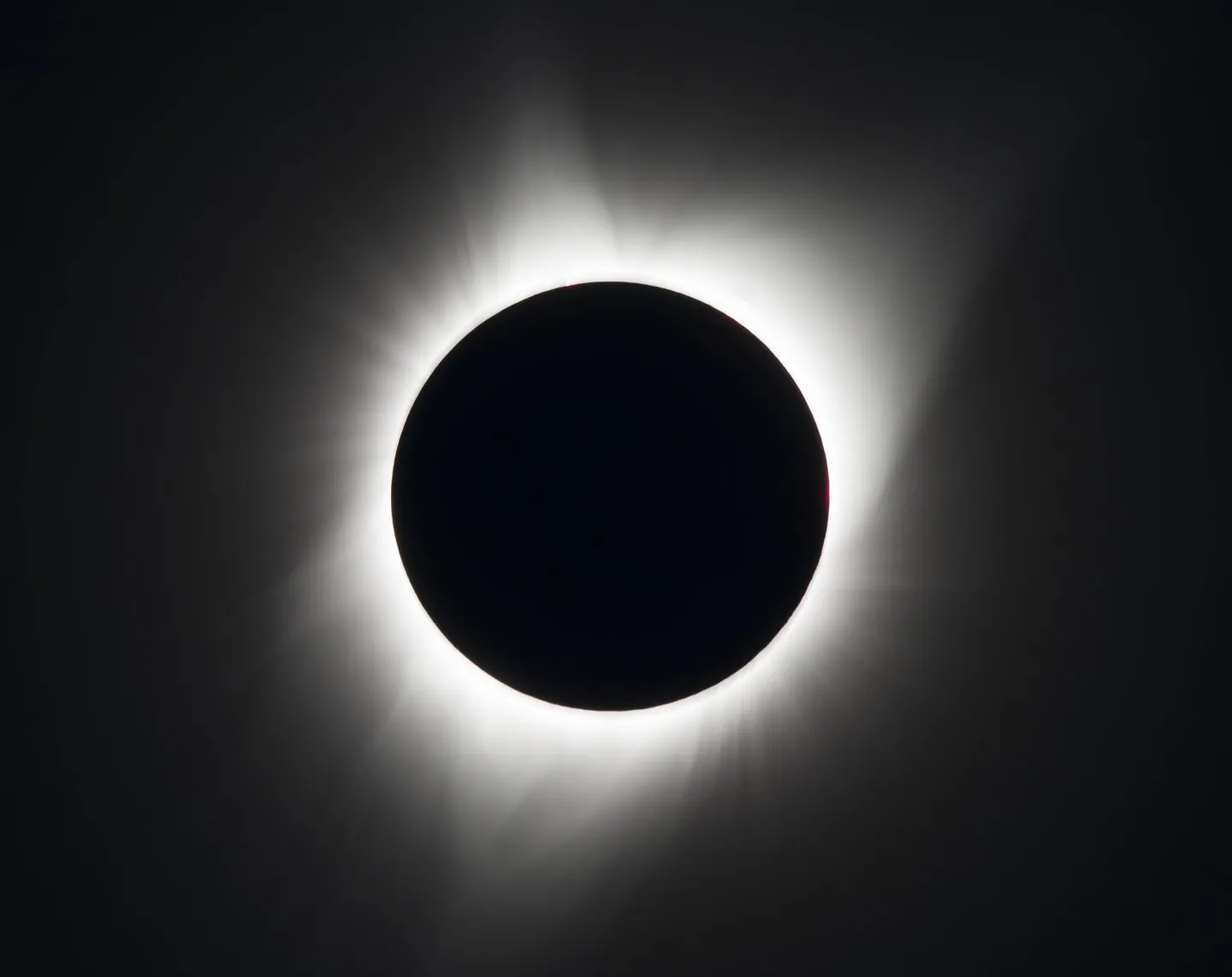
Rahu is the north lunar node. Like Ketu it is a point where the Moon's tilted orbit crosses the plane of Earth's orbit, and like Ketu it has no body, no light and no surface. The photograph above is a total solar eclipse, which happens only when the Sun and Moon align near one of these two points. It is the nearest thing to a picture of Rahu that exists.
Jyotish gives this intersection 18 of the 120 years, more than it gives Jupiter or Mercury. Rahu and Ketu together hold 25 years, a fifth of the cycle, which is more than any single graha.
Rahu owns three nakshatras: Ardra, Swati and Shatabhisha. A Moon in any of them at birth opens the sequence with Rahu.
The largest share of an eighty year life
| Measure | Rahu |
|---|---|
| Length of the mahadasha | 18 years |
| Share of the full 120 year cycle | 15.00% |
| Born into it | 11.11% |
| Share of the years in an 80 year life | 16.77% |
| Runs it at some point before 80 | 85.38% |
| Never runs it before 80 | 14.62% |
| Mean age it begins, where it begins at all | 29.1 |
Source: Natal Junction, exact integration over 1,800,000 birth cases, 20 November 2026.
Set the two share figures side by side and the oddity is plain. Rahu holds 15.00% of a complete 120 year cycle, which is less than Saturn's 15.83% and well under Venus's 16.67%. But across an 80 year life it takes 16.77%, more than Saturn's 16.35% and far more than Venus's 14.25%. It is the largest of the nine.
So the period that occupies most of an actual life is not the longest period in the system. It is the third longest.
Why a finite life does not sample the cycle evenly
The explanation is the mismatch that runs through all nine of these pages, and Rahu is where it shows up most strongly.
Births are spread evenly across the nine lords, one ninth each, because every lord owns exactly three of the 27 nakshatras. The periods are not evenly sized. So births pack densely into the short periods and thinly across the long ones: as many people begin life somewhere inside the Sun's six years as inside Venus's twenty.
That makes the point at which a life enters the wheel uneven, weighted towards the short periods clustered at the start of the order. Those are Ketu at 7, the Sun at 6, the Moon at 10 and Mars at 7. Rahu sits directly after all of them, sixth in the sequence. A dense band of births feeds straight into it, early, and 18 years is long enough to hold them there.
Venus has the opposite problem. It sits second, so the dense band of short-period births lies just past it rather than just before it, and reaching Venus from there means travelling almost the whole cycle.
Lengthen the horizon and the effect fades, as it must. At 90 years Rahu's share falls to 16.09%, closer to the textbook 15.00%. At 60 years it rises to 18.04%. Nobody lives a complete cycle, so nobody gets the textbook proportions.
Rahu also has the second lowest miss rate of the nine at 14.62%, and the earliest mean start age at 29.1. Same cause.
The eighteen years from the inside
Each mahadasha divides into nine antardashas, in the same fixed order, each one proportional to its own lord's length.
| Sub-period | Years | Roughly |
|---|---|---|
| Ketu | 1.05 | 1 years 1 months |
| Venus | 3.00 | 3 years 0 months |
| Sun | 0.90 | 11 months |
| Moon | 1.50 | 1 years 6 months |
| Mars | 1.05 | 1 years 1 months |
| Rahu | 2.70 | 2 years 8 months |
| Jupiter | 2.40 | 2 years 5 months |
| Saturn | 2.85 | 2 years 10 months |
| Mercury | 2.55 | 2 years 7 months |
A Rahu mahadasha opens with its own sub-period of two years and eight months and closes with Ketu, the opposite node, at about a year and a month. Three of the sub-periods here run past two and a half years, which is long enough that practitioners usually go down another level to the pratyantardasha before saying anything specific.
What the tradition reads into it
Rahu is read as appetite, ambition, obsession and the appetite for what lies outside one's existing circumstances. Where Ketu is held to release, Rahu is held to grasp. It is associated with foreignness, with technology and novelty, with crowds and reputation, and with amplification generally: whatever it touches, the tradition says, it enlarges.
The standard image is a severed head without a body, which is the counterpart to Ketu's body without a head. It consumes without being filled, which is as clear a statement of the character as the texts offer.
Rahu is also central to Kaal Sarp dosha, defined by all seven real grahas sitting inside the half of the zodiac running from Rahu to Ketu, and to Grahan dosha, where a light shares a sign with a node. Both are on the doshas page with their rules and their measured frequencies.
Classical material on a Rahu mahadasha describes sudden and unconventional developments, foreign connections and rapid movement in whichever area the chart points to. Being a shadow rather than a body, Rahu is traditionally read through the sign and house it occupies and through its dispositor more than through its own nature.
The three doorways in
Rahu opens from 6 degrees 40 minutes of the three air signs, and its three nakshatras are among the sets that sit wholly inside their signs: Ardra in Gemini, Swati in Libra and Shatabhisha in Aquarius.
The spacing is fixed by the structure. Three nakshatras nine apart is 120 degrees, which is the distance between signs of one element, so every lord's doorways share an element. Rahu's share air.
| Nakshatra | Sidereal span | Deity | Symbol |
|---|---|---|---|
| Ardra | 6°40' Gemini to 20°00' Gemini | Rudra | Teardrop |
| Swati | 6°40' Libra to 20°00' Libra | Vayu | Young sprout in wind |
| Shatabhisha | 6°40' Aquarius to 20°00' Aquarius | Varuna | Empty circle / 100 stars |
The deities make an unusually coherent set. Rudra is the storm, Vayu is the wind and Varuna is the lord of waters and of oaths. Three weather gods, for the one point in the chart that is not a body at all. Shatabhisha carries the most striking symbol of the three, an empty circle, sometimes given as a hundred stars or a hundred physicians, and classical material reads it as the most solitary of the 27.
Where inside the nakshatra the Moon sat decides how much of the eighteen years was already gone at birth:
| Quarter of the nakshatra | Share of the period left | Years left to run |
|---|---|---|
| Pada 1 | 75% to 100% | 13y 6m to 18 years |
| Pada 2 | 50% to 75% | 9 years to 13y 6m |
| Pada 3 | 25% to 50% | 4y 6m to 9 years |
| Pada 4 | 0% to 25% | 0 months to 4y 6m |
5.56% of people born under Rahu have under a year of it left, one of the smallest shares in the system, because a year is a mere eighteenth of eighteen.
That figure completes the argument this page is built on. Rahu takes the largest share of a real eighty year life at 16.77%, it is reached by 85.38% of lives, it begins earlier on average than any other period at 29.1, and when it does open a life it almost never opens as a fragment. By every measure of how much of it a person actually gets, Rahu is the dominant period in Vimshottari, and it belongs to a point in the sky where there is nothing to see.
What it needs in order to be computed
The Moon's nakshatra and the fraction of it already travelled, which means a birth time.
Eighteen years is long enough that an error of a few minutes will not take the period away. What it will do is move the boundaries, and on a period of this length the sub-period boundaries are what a reading actually rests on. A sequence computed from a birth time nobody is confident in gives dates to the day that deserve no such confidence.
The free Kundali computes the whole sequence and names the period running today. The dasha overview explains how the 120 years are divided.
What this page does not do
It does not say what eighteen years of Rahu brings. It sets out how the period is reached, what the tradition holds and what the arithmetic measures.
The figure worth carrying away is 16.77%. More of an average human life runs under Rahu than under any other lord in the system, including the two that are longer, and including every lord that is an actual object.
Frequently asked questions
How long is a Rahu mahadasha?
Eighteen years, the third longest of the nine Vimshottari periods behind Venus at twenty and Saturn at nineteen. Those eighteen years are 15.00% of the full 120 year cycle, but they work out at 16.77% of the years in an 80 year life, the largest share of any of the nine.
Why does Rahu take more of a life than Venus or Saturn when it is shorter?
Because a finite life does not sample the cycle evenly. Births spread evenly across the nine lords but the periods do not, so births pack densely into the short ones, which sit at the start of the order: Ketu, the Sun, the Moon and Mars. Rahu sits directly after all four, so a dense band of births feeds straight into it, early. Venus sits second, with that same band just past it rather than just before it.
Is Rahu a planet?
No. Rahu is the north lunar node, one of the two points where the Moon's tilted orbit crosses the plane of Earth's orbit. It has no body and no light. Eclipses happen only when the Sun and Moon align near a node, which is the one observable consequence of the nodes. Jyotish nonetheless gives Rahu and Ketu 25 of the 120 years between them, more than any single graha.
Which nakshatras begin life in a Rahu mahadasha?
Ardra, Swati and Shatabhisha. A Moon in any of those three at birth opens the dasha sequence with Rahu, with some part of the eighteen years already elapsed depending on how far the Moon had travelled into the nakshatra.
Does everybody get a Rahu mahadasha?
Most people do. We measured 85.38% reaching one before the age of 80, so 14.62% never do. That is the second lowest miss rate of the nine, behind Jupiter, and it begins at a mean age of 29.1, the earliest average start of any period.
Why are all three Rahu nakshatras in air signs?
Because of the spacing rather than any choice. Each lord owns three of the 27 nakshatras set nine apart, nine nakshatras is exactly 120 degrees, and 120 degrees is the gap between signs of the same element. Rahu's three fall at 6 degrees 40 minutes of Gemini, Libra and Aquarius. Their deities make an unusually consistent set as well: Rudra the storm, Vayu the wind and Varuna, lord of waters and of oaths.
Your Birth Chart Report
Your own chart, computed and read
A personal report reads your Western chart in full. The free Kundali on this site computes your sidereal chart, your nakshatra and the dasha period running today.
For self-reflection and entertainment. Astrological insights drawn from your birth details, not predictions, and not medical, legal, financial or psychological advice.