The Ketu Mahadasha: 7 Years, Measured
Seven years under the one lord in the system that has no body, no light and nothing to photograph. The shortest period but one, with the arithmetic shown.
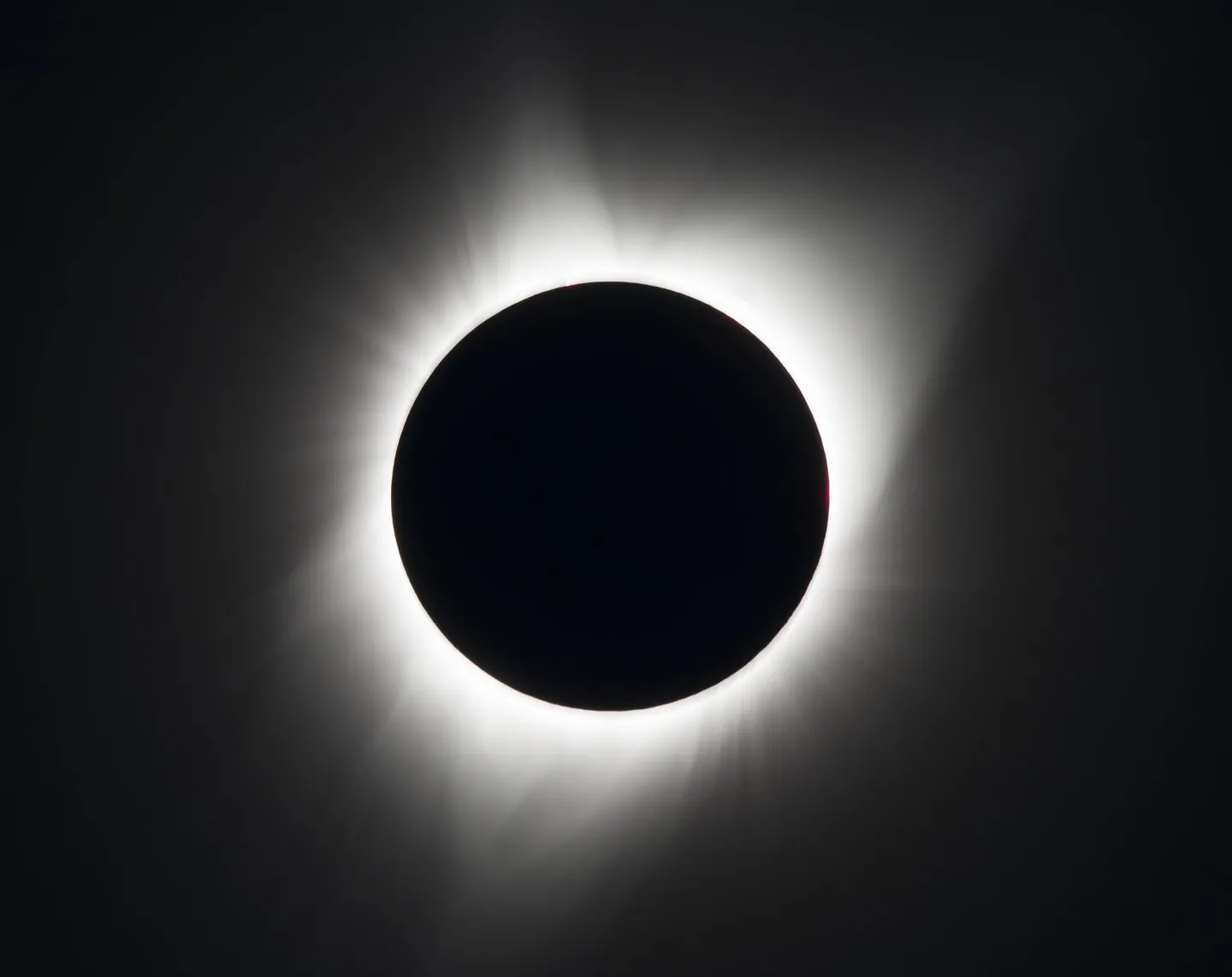
The Ketu mahadasha runs 7 years, and it is the period that opens the whole Vimshottari cycle. It is also the only one of the nine, along with Rahu, whose lord is not an object. There is no photograph of Ketu at the top of this page, because there is nothing to photograph.
That is not a quibble. It is the first thing worth understanding about this period.
The lord that is not there
Ketu is the south lunar node. The Moon's orbit is tilted about five degrees against the plane of Earth's orbit, so it crosses that plane twice each circuit. Those two crossing points are Rahu and Ketu. They are geometry, not matter. Nothing occupies them, nothing shines from them and no telescope has ever resolved one.
What the crossings do produce is eclipses, which can only happen when the Sun and Moon line up near a node. The image above is a total solar eclipse, which is as close to a photograph of Ketu as anybody can get: not the point itself, but the one thing that proves where it is.
Classical Jyotish treats both nodes as full grahas with full periods anyway, and gives them 7 and 18 years of the 120. A system that hands a seventh of a human life to a geometric intersection is making a claim worth noticing, whatever a reader makes of it.
Why the cycle starts here
The Vimshottari order runs Ketu, Venus, Sun, Moon, Mars, Rahu, Jupiter, Saturn, Mercury. Ketu is first, which is why lists of the nine periods almost always open with it.
That ordering is not a ranking. It is the sequence of nakshatra lords: the 27 nakshatras are assigned to the nine lords three times round in exactly this order, starting from Ashwini, the first nakshatra. Ketu is first because Ashwini is first.
Ketu owns Ashwini, Magha and Mula. A Moon in any of those three at birth means a life that opens inside a Ketu mahadasha, with up to seven years of it still to run.
Those three nakshatras share a quality the tradition finds telling. Ashwini opens the zodiac, Mula sits at the galactic centre and carries the name "root", and Magha is the seat of the ancestors. All three are read as thresholds rather than settled ground.
How much of a life it takes
| Measure | Ketu |
|---|---|
| Length of the mahadasha | 7 years |
| Share of the full 120 year cycle | 5.83% |
| Born into it | 11.11% |
| Share of the years in an 80 year life | 5.25% |
| Runs it at some point before 80 | 70.00% |
| Never runs it before 80 | 30.00% |
| Mean age it begins, where it begins at all | 37.6 |
Source: Natal Junction, exact integration over 1,800,000 birth cases, 20 November 2026.
Three people in ten never run a Ketu mahadasha. Not because it is rare in any mystical sense, but because 7 years out of a 120 year wheel is a narrow target and a life only ever travels two thirds of the wheel.
One in nine is born into it, the same as every other lord, because each owns exactly three nakshatras. The 7 year length has nothing to do with how likely you are to start there. It only decides how long you stay.
What actually decides whether you reach it
This is the part that is genuinely counterintuitive, and it applies to all nine periods.
Whether a given mahadasha arrives in your life has very little to do with how long that period is. What matters is how much of the cycle stands between where you are born and where it sits.
Ketu is reached from Mercury after Mercury's remaining years, and from Saturn after Saturn's 19 plus Mercury's 17, which is already 36 years of waiting before it begins. From Rahu you would need to clear Jupiter, Saturn and Mercury first, 52 years before Ketu starts. From Venus, a birth in the lord immediately after Ketu, the wait is the whole rest of the wheel, 113 years, so it never comes at all.
That is the whole mechanism. Each lord is reachable from the handful of lords sitting behind it within 80 years of runway, and from nowhere else. Ketu sits at the back of a long queue of the three longest periods in the system, which is why 30% of people miss it despite there being nothing unusual about it.
The seven years from the inside
A mahadasha divides into nine antardashas, in the same fixed order, each one proportional to its own lord's length. For a 7 year period the slices are short.
| Sub-period | Years | Roughly |
|---|---|---|
| Ketu | 0.41 | 5 months |
| Venus | 1.17 | 1 years 2 months |
| Sun | 0.35 | 4 months |
| Moon | 0.58 | 7 months |
| Mars | 0.41 | 5 months |
| Rahu | 1.05 | 1 years 1 months |
| Jupiter | 0.93 | 11 months |
| Saturn | 1.11 | 1 years 1 months |
| Mercury | 0.99 | 12 months |
The Ketu-Ketu sub-period that opens the run is about five months, which is among the shortest named spans in the whole system. The Ketu-Venus that follows it is the longest here at a little over fourteen months, because Venus is the longest lord. Nothing inside a Ketu mahadasha lasts a year and a half.
That matters for how the period is read. A 19 year Saturn mahadasha can be discussed in broad strokes and still mean something. Seven years cut into nine pieces cannot, so the sub-period does most of the work.
What the tradition reads into it
Ketu is read as the graha of release, detachment and whatever is finished with. Where Rahu is held to grasp, Ketu is held to let go. It is associated with the part of a life that is already complete, with renunciation, with solitary or inward pursuits, and with skill that arrives without obvious training.
The standard image is a body without a head, which carries a double meaning the texts use deliberately: acting without deliberating, and also perceiving without needing to look. Ketu is tied to moksha, the last of the four aims of life, in a way none of the other eight are.
Classical material on a Ketu mahadasha describes loosening rather than building, interests falling away without a clear replacement, and a pull towards the margins of whatever was previously central. The same material insists on reading the house Ketu occupies and the lord of that house, because a 7 year label on its own says very little.
A fifth of the cycle belongs to two things that are not there
Ketu never appears alone. The two nodes are the two ends of one line, always exactly opposite each other, always six signs apart. Where Ketu is, Rahu is directly across the chart, and the two move together, backwards through the zodiac, taking about eighteen and a half years to complete a circuit.
Put their periods side by side and the system makes a striking allocation.
| Lord | Years | Share of the cycle |
|---|---|---|
| Rahu | 18 | 15.00% |
| Ketu | 7 | 5.83% |
| Both nodes | 25 | 20.83% |
A fifth of the entire Vimshottari cycle, 25 of its 120 years, is handed to two points with no body, no light and no substance. More than Saturn. More than Venus. The only two lords in the scheme that are not objects between them hold more of a life than any single graha does.
Whatever a reader concludes from that, it is not an accident or an oversight. The tradition weights the nodes deliberately and heavily, and the same emphasis turns up elsewhere: Kaal Sarp dosha, one of the best known conditions in the whole subject, is defined entirely by where the seven real grahas sit relative to the Rahu to Ketu axis.
The practical consequence is that a Rahu mahadasha and a Ketu mahadasha are never far apart in the sequence. Rahu sits sixth in the order and Ketu first, so Ketu follows Mercury which follows Saturn which follows Jupiter which follows Rahu. Between the end of a Rahu period and the start of a Ketu one lie Jupiter, Saturn and Mercury, 52 years of the three longest periods in the system. The two nodes are adjacent in space and about as far apart in time as the cycle allows.
The three doorways in
Ketu's three nakshatras sit at the very start of the three fire signs: Ashwini at the first degree of Aries, Magha at the first degree of Leo and Mula at the first degree of Sagittarius.
That is not a coincidence, and it is worth understanding once because it holds for all nine lords. Each lord owns three of the 27 nakshatras, spaced nine apart. Nine nakshatras is exactly 120 degrees, and 120 degrees is the spacing of a triplicity. So a lord's three doorways always open in the same element. Ketu's open on fire, on the opening degree of each fire sign.
| Nakshatra | Sidereal span | Deity | Symbol |
|---|---|---|---|
| Ashwini | 0°00' Aries to 13°20' Aries | Ashwini Kumaras | Horse's head |
| Magha | 0°00' Leo to 13°20' Leo | Pitris | Throne |
| Mula | 0°00' Sagittarius to 13°20' Sagittarius | Nirriti | Tied roots |
A Moon anywhere in those three arcs at birth opens the sequence with Ketu. Together they come to 40 degrees of the 360, which is 11.11%, and that is the whole reason a birth falls under any given lord with the same one in nine chance however long its period runs.
Those three opening degrees carry a name of their own. The junction where a water sign ends and a fire sign begins is called gandanta, the knot, and classical texts treat the degrees either side of it as the most delicate in the zodiac. Ketu's three nakshatras all begin on the far side of a gandanta knot. Mercury's three all end on the near side of the same three junctions, which is why those two lords sit at opposite ends of the cycle's order.
The nakshatra does more than name the first lord. Where inside it the Moon fell decides how much of the seven years had already run before the first breath. A Moon at the opening minute of Mula carries nearly the whole period forward. A Moon in the last degree of Mula carries almost none of it.
Each nakshatra divides into four padas of 3 degrees 20 minutes, and the pada is the quickest way to read the balance:
| Quarter of the nakshatra | Share of the period left | Years left to run |
|---|---|---|
| Pada 1 | 75% to 100% | 5y 3m to 7 years |
| Pada 2 | 50% to 75% | 3y 6m to 5y 3m |
| Pada 3 | 25% to 50% | 1y 9m to 3y 6m |
| Pada 4 | 0% to 25% | 0 months to 1y 9m |
Seven years is short enough that this matters more here than in most of the cycle. 14.29% of people born under Ketu have under a year of it left, the second highest share in the system behind the Sun. For them the Ketu mahadasha is not a chapter of childhood at all. It closes before memory starts, and the twenty years of Venus follow.
What it needs in order to be computed
The Moon's nakshatra and the fraction of it already travelled, which means a birth time, and a good one.
The Moon crosses a nakshatra in roughly a day, so being out by ten minutes moves every boundary in the timeline. For a 7 year period that error lands proportionally harder than it does on a 20 year one: ten minutes of birth time can move a Ketu sub-period of five months by a noticeable fraction of itself.
The free Kundali computes the full sequence and names the period running today. The dasha overview explains how the 120 years are divided in the first place.
What this page does not do
It does not say what a Ketu period does to you. It sets out how the period is reached, what the tradition holds about it and what the arithmetic measures. Three people in ten never meet it, and that figure belongs beside anything else anyone tells you about it.
Frequently asked questions
How long is a Ketu mahadasha?
Seven years. It is tied with Mars as the second shortest of the nine Vimshottari periods, ahead of only the Sun at six. Those seven years are 5.83% of the full 120 year cycle and 5.25% of the years in an 80 year life.
Why does the Vimshottari cycle begin with Ketu?
Because the nakshatras are assigned to the nine lords in a fixed repeating order starting from Ashwini, the first nakshatra, and Ashwini belongs to Ketu. The order is the sequence of nakshatra lords, not a ranking of importance. It runs Ketu, Venus, Sun, Moon, Mars, Rahu, Jupiter, Saturn then Mercury.
Is Ketu a planet?
No. Ketu is the south lunar node, one of the two points where the Moon's tilted orbit crosses the plane of Earth's orbit. It is a geometric intersection with no body and no light, which is why there is no photograph of it. Eclipses can only happen near a node, which is the one observable thing the nodes produce.
Which nakshatras begin life in a Ketu mahadasha?
Ashwini, Magha and Mula. A Moon in any of those three at birth means the dasha sequence opens with Ketu, with some part of the seven years already elapsed depending on how far the Moon had travelled into the nakshatra.
Does everybody get a Ketu mahadasha?
No. We measured 30.00% of lives never reaching one before the age of 80, the second highest miss rate of the nine. It is not about the period being short. Ketu sits behind Rahu, Jupiter, Saturn and Mercury in the sequence, which is 70 years of the longest periods in the system, so a birth in that stretch runs out of life before Ketu arrives.
Your Birth Chart Report
Your own chart, computed and read
A personal report reads your Western chart in full. The free Kundali on this site computes your sidereal chart, your nakshatra and the dasha period running today.
For self-reflection and entertainment. Astrological insights drawn from your birth details, not predictions, and not medical, legal, financial or psychological advice.